
Showing posts with label Investigation. Show all posts
Showing posts with label Investigation. Show all posts
Friday, January 09, 2009
What Are the Effects of Erosion?
This is the video that I created for our demonstration of erosion. After our class discussion, comment on why the humus and clay seemed to erode more than the sand and the gravel. You may want to look at the model again.


Wednesday, December 10, 2008
Creating a Model of Erosion
For the first experiment on weathering and eroding we took a look at what kind of erosion can take place when water runs off the Earth's surface. To record the video I set up a tripod above the glass aquarium to get a good top-down view of the action. I placed my web cam on the tripod connected to my laptop. I streamed the video from my laptop to Ustream. When I was ready to do the investigate, I hit the record button on Ustream to record it. Because of of the size of the aquarium, I used a 2 gallon bucket of water to simulate water run-off. I used my digital camera to take pictures to record what the web cam could not.

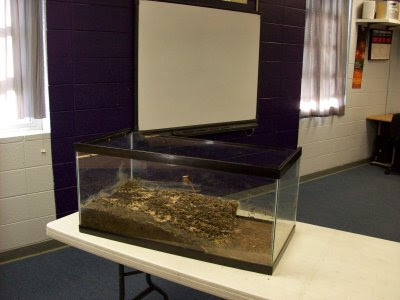
Here is a picture from the top down taken before I poured the water on the model. The soil was created using four substances: humus, sand, gravel, and clay. I added water to make the soil more realistic. The water I mixed in also helped keep all the water I poured on the model from being absorbed into the soil. Although you may not be able to see from this angle, I also slightly sloped the soil so the water would be able to run-off.
Here is the video of the water being poured on the soil. Notice the path the water takes. When the water is done moving, can you tell where the water was?
Here is a top down view. Compare it to the original picture taken before the water was poured onto the model. Can you see a difference? How is it different?
 This is a side view of the model. Notice the water under the surface of the soil. How did that water get there? What is that water called? Do you think the water stayed there, or did it move later?
 Here is a picture of the bottom of the model where the soil ended. Describe what you see. How is it different than before the water ran over it? In the top part of the picture is where the water ran off. Why is it so dirty? What do you think is in the water that makes it so dirty? Does this help illustrate the watershed concept?

This is a close-up picture of the soil after the water ran off it. What do you see? Is the soil still mixed up or has it separated? Does this look like a stream bed?
Now that the experiment has been completed, what could we change to create a new experiment? Does this model help you with the part of the water cycle that takes place on the surface of the Earth?

Here is a picture from the top down taken before I poured the water on the model. The soil was created using four substances: humus, sand, gravel, and clay. I added water to make the soil more realistic. The water I mixed in also helped keep all the water I poured on the model from being absorbed into the soil. Although you may not be able to see from this angle, I also slightly sloped the soil so the water would be able to run-off.

Here is the video of the water being poured on the soil. Notice the path the water takes. When the water is done moving, can you tell where the water was?
Here is a top down view. Compare it to the original picture taken before the water was poured onto the model. Can you see a difference? How is it different?
 This is a side view of the model. Notice the water under the surface of the soil. How did that water get there? What is that water called? Do you think the water stayed there, or did it move later?
 Here is a picture of the bottom of the model where the soil ended. Describe what you see. How is it different than before the water ran over it? In the top part of the picture is where the water ran off. Why is it so dirty? What do you think is in the water that makes it so dirty? Does this help illustrate the watershed concept?
This is a close-up picture of the soil after the water ran off it. What do you see? Is the soil still mixed up or has it separated? Does this look like a stream bed?

Now that the experiment has been completed, what could we change to create a new experiment? Does this model help you with the part of the water cycle that takes place on the surface of the Earth?
Monday, November 17, 2008
Evaporation in the Water Cycle

In class we had a demonstration of evaporation. The problem was to determine what happens to something that is mixed with water when the water evaporates. Does the stuff mixed in the water evaporate too?
I took water and added food coloring in one container and salt in the other. I heated the water and evaporated it out of the container. The students looked at the containers and noticed something was left behind. What does this mean? What was left behind?
Wednesday, September 24, 2008
Salt Water Golf Ball Float
A great experiment coupled with a catchy song. Thanks class and thanks Animoto.
This is the last experiment of the unit on Scientific Inquiry. We covered every objective and now all that is left is the Boat Regatta.
Monday, September 22, 2008
Boat Regatta

It is time for the annual Boat Regatta. Here is your opportunity to use all you know about floating and sinking to create your own boat. Here are the rules:
1. You may only use glue and craft sticks.
2. Decorating the boat is okay, but not necessary.
3. Boats must be no larger than 10 inches in any direction.
4. When the boat sinks or breaks apart, it is out of the contest.
5. Everyone is required to make a boat.
Good luck!
Wednesday, September 17, 2008
Ivory Boat Sink
After the students demonstrated their skill at creating soap boats that floated, I challenged them to create a soap boat that would sink. With this experiment the students had to carve a boat shape they thought would sink. Many thought that it would be no problem to sink a bar of ivory, all they needed was to put a hole in the bottom.
The experiment surprised most of the students, they discovered that Ivory soap would not sink in the water. Here is why.
The experiment surprised most of the students, they discovered that Ivory soap would not sink in the water. Here is why.
Soap Boat Float
Every year we do a project where students bring a bar of non-Ivory soap. They carve the soap to resemble a boat. The object is for them to make a boat that will float.
Here are some of the students carving their boats.
After they carve their boats, I ask them why they chose to carve them the way they did. Here are some of the responses.
Most of the boats did float. Boats that had holes in the bottom, or that had low walls on the side did tend to sink. It was demonstrated that the soap would all sink if pushed under water. Afterwards, we discussed why some of the boats floated while others didn't.
Here are some of the students carving their boats.
After they carve their boats, I ask them why they chose to carve them the way they did. Here are some of the responses.
Most of the boats did float. Boats that had holes in the bottom, or that had low walls on the side did tend to sink. It was demonstrated that the soap would all sink if pushed under water. Afterwards, we discussed why some of the boats floated while others didn't.
Tuesday, September 09, 2008
Making Aluminum Foil Boats Float
Did you know that a 4x4 inch foil boat can carry 1/3 of the amount of marbles a 6x6 in foil boat can carry? When you find the amount of cubic inches for each, the 6x6 boat has almost 3 times as much volume! This means that big boats can hold much more than smaller boats.
Friday, September 05, 2008
Understanding Background (Prior) Knowledge
The reason we identify background knowledge in our model of the Scientific Method is so we can stimulate our brain and prepare it to accept new knowledge. It is important to think about things we know so we can connect them to things we want to learn.
Today I want you to identify what you have learned so far about floating and sinking. Look back to the past experiments and demonstrations including the testing of objects to see if they floated and your experiences with the clay boats. What have you learned so far about floating and sinking? I would like you to identify five things you have learned. Use correct grammar, punctuation, and spelling in complete sentences.
Today I want you to identify what you have learned so far about floating and sinking. Look back to the past experiments and demonstrations including the testing of objects to see if they floated and your experiences with the clay boats. What have you learned so far about floating and sinking? I would like you to identify five things you have learned. Use correct grammar, punctuation, and spelling in complete sentences.
Tuesday, September 02, 2008
Clay Boat Float
The students are trying to create shapes that will hold the most marbles. Through the course of the activity, I am hoping they come to the realization that a normal boat shape is not the best shape for floating marbles.
Here is an example of a canoe shaped boat.
Another group created an oval shape to hold the marbles.
Miguel and Yengshi took an early lead with 27 marbles. Can you identify why their boat held more marbles than the first two boats?
Here is Miguel explaining why he chose his shape. Do you think he chose the best shape? Do you think there is another shape that will work better? How would you find the best shape?
Here is an example of a canoe shaped boat.
Another group created an oval shape to hold the marbles.
Miguel and Yengshi took an early lead with 27 marbles. Can you identify why their boat held more marbles than the first two boats?
Here is Miguel explaining why he chose his shape. Do you think he chose the best shape? Do you think there is another shape that will work better? How would you find the best shape?
Thursday, August 28, 2008
Investigation 2 Which Objects are Lightest?
Sarah puts her objects in order from lightest to heaviest. Did you put yours in the right order?
Investigate 3 Which Objects Will Float?
After observing the objects float or sink, what is your hypothesis for the question, "Why do some things float while others sink?" Look carefully at the objects that floated or sunk to see if you can come up with a logical reason.
Tuesday, August 19, 2008
Floating and Sinking Investigate 1
For our first experiment of the year, we brought five objects from home to test to see if they would float or sink. Here is Tristan explaining what he thinks his objects will do.
Here is video of Tristan doing the experiment. He puts each object in the water to see if it will float or sink.
What happened to your five objects, did they float or sink? Write what your objects are and what happened to them.
Here is video of Tristan doing the experiment. He puts each object in the water to see if it will float or sink.
What happened to your five objects, did they float or sink? Write what your objects are and what happened to them.
Monday, August 18, 2008
Science Unit Floating and Sinking
We examine the Scientific Method through our unit on Floating and Sinking. The video shows the opening demonstration of our unit. The students are asked to describe why one acrylic bead floats while the other sinks. They will not learn the answer until close to the end of the unit.
The essential question for this units is: Why do some things float while others sink?
Thursday, June 26, 2008
Summer School Investigate 5 One Bad Reaction
What do you think? Can you think of anything that bubbles up like that?
Tuesday, June 17, 2008
SS Investigate 4 Goopy Stuff
We are experimenting with two solutions, polyvinyl alcohol in water and borax in water. When we mix them interesting things happen. Here is a link to our Scientific Method write-up.
After conducting your experiment, what 2 questions do you have?
After conducting your experiment, what 2 questions do you have?
Monday, June 16, 2008
SS Investigate 3 Revisited


After leaving the eggs in the vinegar over the weekend, how did they change? Compare and contrast the egg before and after we placed it in the vinegar. Identify whether it was a physical change, chemical change, or both.
Friday, June 13, 2008
Having Fun in Summer School?!
BubbleShare: Share photos - Find great Clip Art Images.
Hooray! We are half-way through summer school! What is the best class or activity you have had so far and why was it so great!
Hooray! We are half-way through summer school! What is the best class or activity you have had so far and why was it so great!
Thursday, June 12, 2008
SS Investigate 3 An Eggciting Eggsperiment
Our next experiment deals with chemical changes. After observing what happened to several substances we combined, we added vinegar to an egg to see what would happen. What did you observe when the egg was combined with the vinegar?
Wednesday, June 04, 2008
SS Experiment 2

In the second experiment you were given the task to see if the temperature of water effects the rate of dissolving. What did you learn?
Subscribe to:
Posts (Atom)